




How to Grow Small Cannabis Plants in Tiny Spaces


- 1. What your grow space needs
- 2. What to have in mind when growing in tiny spaces?
- 3. How to grow cannabis in tiny spaces
- 3. a. Picking the right strain
- 3. b. Proper pot size
- 3. c. Choosing the correct light fixture
- 3. d. The ideal light spectrum
- 3. e. Performing plant training
- 4. What works best: autoflowers vs photoperiods
- 5. Mini indoor stealth grow tent setup
- 6. Extra tips
- 7. Keep in mind!
- 8. In conclusion
It's 2026, and everyone wants to have the curing jars full without having to spend too much. Fortunately, there’s an easy way to do it: growing your own. But having a 2-meter-high grow tent may not be feasible for all. Growing small cannabis plants consists of using low-stress and high-stress plant training techniques to adjust and shape your cannabis plant to a limited grow space. So if you want to learn how to grow good flowers in tiny spaces, here are the best tips and tricks to help you achieve excellent harvests with your autoflower or feminized seeds!
1. What Your Grow Space Needs
It doesn’t matter how big or small your grow space is. It can be as little as 60 x 60 x 120 cm or as big as a greenhouse, but all of them need the following to sustain healthy plant growth:
- Enough space for plant growth; the bigger the plant, the more vertical space you’ll need to keep the light fixtures a safe distance from your plants.
- Cleanliness. Dirty grow tents can attract mold, pests, and diseases. Additionally, your growing space should be properly isolated from the outside environment to minimize the risk of contamination and pest infestations.
- Proper ventilation. Plants need fresh air, so continual air exchange is needed for healthy plant growth. So make sure to have an extractor or an intake fan to avoid stale air in your grow tent.
Remember, it doesn’t matter how big or how small your grow space is. You need to be able to control the growing conditions (at least to a certain extent) to grow healthy cannabis plants without major issues.
2. What To Have In Mind When Growing In Tiny Spaces?
Growing small plants isn’t any different than growing big plants, but there are a couple of things to have in mind because you don’t have a lot of space, but you still want to get a great harvest. The lack of space basically forces you to adjust minor things, including the genetics, grow setup, and other growing practices in order to minimize vertical growth while maximizing horizontal growth.
Choosing Genetics
The most important factor when growing in small spaces is genetics. You definitely can grow any strain and train it daily to control height, but it’s a lot of work, so you want to grow a strain that naturally stays small. For this type of growing, the best option is short autoflowering strains such as our Purple Haze Auto.
This strain grows between 60 - 100 cm in height and finishes its entire life cycle in 8 weeks. Short photoperiod strains can work too, but it’s recommended to go for autos because they are faster and tend to grow more compact.
Grow Setup
When talking about tiny grow spaces, there are a couple of things that can make your life easier and avoid problems further into the flowering stage.
The first one is to choose the right light fixture. Due to the grow space being small, you can grow from seed to harvest with fluorescent lights or cheap LEDs.
The second one is to use small pots. As you may know, the bigger the pot, the bigger the plant, so make sure to grow in the smallest pots possible (around 1 - 5 liters). This will help keep your plants small.
The third one is to go for certain plant training techniques such as Scrog, SoG, or the tie-down method, which will also help you keep your plants short and will allow you to shape them however you want or need to, depending on what works best for you and your growing space.
3. How To Grow Cannabis In Tiny Spaces
Most growers believe that growing in small places is hard, but it doesn't have to. As mentioned, there are a lot of strains that grow short naturally and can produce excellent flowers. As a matter of fact, you can even grow tall plants in tiny spaces (with proper training, obviously) and still get good yields. So if you were looking for how to do it, read along with all you need to know!
Picking the right strain
Some strains are labeled as “XL” or just have a tendency to grow tall no matter what you do, so stay away from them. On the other side, this means that you can find small strains that will stay short without doing anything extra. For example, autoflowering strains start flowering in 4-5 weeks from seed and are usually ready for harvest in 2 - 2.5 months. Due to the quick grow cycle, almost all autoflowers stay relatively short but have in mind that even autoflowers may grow too big depending on your grow space so make sure to go for the smallest autoflowers, just to be safe.

Another good option is to go for fast or express flowering strains, which usually grow short due to the shorter life cycle. Now, not all fast flowering or express-flowering strains tend to grow short, so pay attention to the strain description to know what to expect. If you end up choosing photoperiod cannabis plants instead of fast-flowering or autoflowers, make sure to grow under 12/12 from seed or flip to 12/12 after 3 - 4 weeks in the vegetative stage. A longer vegetative cycle might cause the plants to overgrow your tent.
Proper Pot Size
Restricting root space is essential if you want your plants to grow short. More experienced growers can get away with growing outstanding plants in solo cups, but if you’re a beginner, you can grow in 1 - 5 liter pots (or smaller if needed) without a problem at all. As long as you keep your plants well-fed and avoid nutrient deficiencies, you should get excellent results.
Choosing The Correct Light Fixture
Using the right grow light is essential for growing healthy small plants. Fluorescent bulbs and certain LEDs are perfect for small grow spaces because you can keep them very close to the canopy without burning or bleaching your plants.
Compact Fluorescent Lights
Compact fluorescent lights are great for small spaces and small plants, but they can emit heat and can be too big for small spaces. It’s only recommended to use them if it’s the only type of bulb you can find.
T5 Fluorescent Lights
T5 fluorescent bulbs are bigger than regular CFLs and can be kept closer to plants while producing excellent yields when growing in a Scrog or SoG (or basically any training technique that allows you to grow an even canopy).

The downside is that when compared to LEDs, T5s get much hotter, and for the same electricity consumption, the yields per watt aren’t even close.
LED Lights
LEDs are the best choice because they come in different sizes and shapes, so you’ll be able to fit them in any setup. Most LED fixtures are quite efficient and don’t emit a lot of heat while producing about twice the yield per wattage when compared to T5s or CFLs, making them perfect for tiny grow spaces. On top of choosing the right light fixture, keep the light as close as possible because it helps keep plants shorter, but make sure the light intensity is not too strong, or it might end up causing problems.
The Ideal Light Spectrum
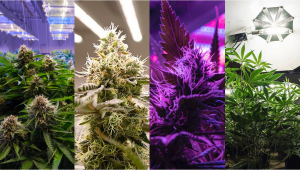
Grow lights with more blue spectrum can help you keep your plants short during the vegetative stage, while grow lights with more red spectrum encourage stretching, so make sure to know exactly what you’re buying or what you have. If you are planning on using LEDs, try to go for LEDs with separate Veg and Bloom switches or go for full-spectrum LEDs, and if you’re growing with light bulbs, make sure the spectrum ranges between 4000 Kelvin and 6500 Kelvin.
Performing Plant Training
Even if you’re growing a strain that grows short naturally, plant training techniques give you the power to control plant growth. When growing in tiny spaces, the best training methods are:
- Sea of Green;
- Screen of green;
- The tie-down method and;
- Super cropping.
Training techniques such as the tie-down method and super cropping are super useful if you’re already growing small plants and need to adjust a couple of branches or make any minor adjustments. Methods such as Sea of Green and Screen of Green are also great if you’re already growing short strains but want to even the canopy to get more light coverage or improve bud quality, but if you’re growing plants that you 100% know will get too big for your grow space, you should use high-stress training techniques such as topping.
Topping your cannabis plants causes them to spread out more, which is of great help when dealing with restricted spaces. Remember that when dealing with autoflowers, it’s not recommended to top them because it can stunt growth, but in this case you want small plants, so you can top your autoflowers, even after they’ve started growing flowers. Doing it at just the right moment will result in small plants full of extra-dense buds.
4. What Works Best: Autoflowers vs Photoperiods
There’s no right or wrong when choosing what strain to grow. As long as your plants don’t overgrow your tent, you’ll have great results with any type of strain. Just keep in mind that photoperiod strains grow taller and do not flower automatically. You need to change the light cycle to 12/12 in order to trigger flowering. When you flip to 12/12, your plants can double in size, so don’t wait too long and, if possible, provide a 12/12 cycle from seed or flip to 12/12 once your plant is about half of the desired size.
If you opt for autoflowers, try to find quick Indica-leaning strains. They should grow fairly short while still being able to produce fat buds. If you’re not sure what to grow, here are our recommended strains.

5. Mini Indoor Stealth Grow Tent Setup
Now that you know everything you know about growing cannabis in small spaces, it’s time to grow! For those of you who got excited and want to get growing asap, here’s a quick DIY small tent setup for you to grow excellent buds stealthily.
As mentioned, when dealing with limited spaces, you want to get the best harvest possible while still growing small plants and in the stealthiest way possible so this grow setup focuses on growing as much bud as possible while still being super stealthy so it won’t emit any noise or reek smell, meaning that you won’t have to worry about anything other than taking care of your plants. Here’s what you’ll need:
Light Fixture
For the light fixture, it’s recommended to get a 100 watts full-spectrum LED. This type of LED goes for around $80 - $150 and is super small, doesn’t emit much heat, and provides a full spectrum. This way, you don’t have to change the light bulb when your plants start flowering, which is a plus. If you don’t want to spend that much on an LED, go for a 4000k bulb for the vegetative stage and around 2100k for the flowering stage. Light bulbs are usually cheaper than LEDs, but you’ll have to change one for the other every time your plants start flowering, so make sure to think about what works better for you.

Fertilizers
There are at least a couple dozen fertilizer brands on the market, so use what’s easier for you and what you can afford. There’s no need to spend hundreds on fertilizers. If you’re in doubt, go for slow-release powdered organic nutrients, which make feeding much simpler and work like a charm.
Exhaust Fan and Carbon Filter
If you’re planning on filling your grow tent or just don’t want to attract unwanted attention, you need an exhaust fan and a carbon filter. The exhaust fan will ensure the humidity doesn’t get out of control, while the carbon filter ensures there’s no weed smell wafting out of your grow tent.

Due to the size of the grow tent, you don’t need a huge carbon filter and exhaust, so just get the smallest or cheapest you can find. A simple exhaust fan should go for around $35 and a carbon filter for as little as $40.
Pots
For the pots, you can basically use whatever you want. You don’t even need to use pots. You can use any type of small container. Just remember that the containers should be around 1 - 5 liters (depending on the final plant size you want to achieve)and have drainage holes on the bottom. And, for the best results possible, try to go for fabric or smart pots, which provide the best oxygenation to the roots. This way, you prevent overwatering. Smart pots go for about $2-3 and fabric pots for around the same, so you shouldn’t spend more than $10.
Grow Tent
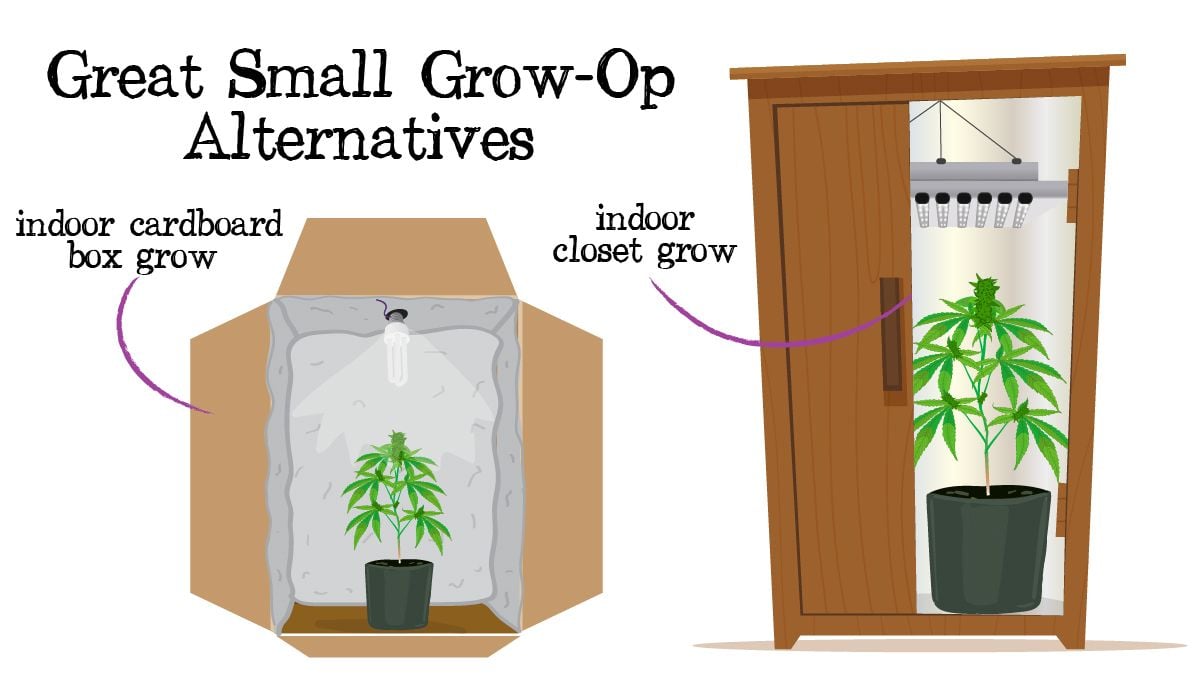
As for the grow space itself, you don’t actually need to buy a grow tent because you can grow inside your closet or any small cabinet, but for those who don’t have the required space, you can go ahead and get the cheapest 60 x 60 x 90 cm grow tent, which should cost less than $60.

If you can afford it and have enough space, go for a 60 x 60 x 120 cm tent. It will be much, much better and prevent problems further into the grow cycle. Remember, there are a lot of different grow tents on the market, and you can also build your own tent, so don't worry about finding the right one.
Optional Equipment
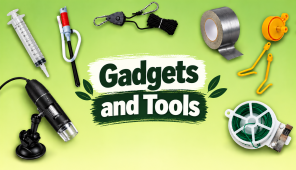
Now that you have the basics, it’s time to get the smaller things. In order to get your tent up and running, you’ll also need a timer, a thermometer, and a hygrometer.
Getting a timer is not obligatory but you want to get one in order to automate tuning the lights ON and OFF. You don’t need to get an expensive one. Get the cheapest one, and you’re done. As for the hygrometer and thermometer, get the cheapest one but make sure it has a probe for improved accuracy.
Once you get everything together, it’s just a matter of setting up your grow tent. Have in mind that a small grow tent can fit up to 4 - 5 plants but you can build your own grow spaces to fit just 1 or 2 plants. For example, if you don’t smoke too much, you can build a space bucket and harvest excellent flowers while spending less than $100, or you can even spend less and grow in your closet; it’s just a matter of seeing what works best for you.
6. Extra Tips
On top of the things mentioned above, there are other growing practices that may not be suited for all growers but can definitely give you an advantage if you can or know how to do it.
Keep the light fixture as close as possible
Keeping the light fixture as close as possible to the canopy will help keep your plants shorter.
Top your plants when possible
If your plants are in good health, you can top them to promote more horizontal growth, minimizing plant height while creating more flowering sites.
The Tie-Down Method
You can tie down the branches to get your plant to stay in the desired shape and size. This method works even if your plants are already too big.
Don’t Veg Photos For Too Long
If you’re growing photoperiods, do not let them grow too much because some strains can double in size when flipped to 12/12. If possible, grow them under 12/12 from seed so they start flowering as soon as possible. Obviously, this doesn’t apply to autoflowers. For autoflowers, just let them do their thing, and they’ll flower as soon as they can.
7. Keep In Mind!
Now you know everything you need to grow beautiful, healthy cannabis plants in tiny spaces, but remember that it doesn’t matter how small or big your grow space is. Keep the following things in mind to avoid issues throughout the grow cycle.
Prevent Light Burn
One of the most important things when growing in tiny spaces is the lights because grow lights usually run hot and need to be kept at a certain distance from your plants to avoid light burn. So you have two options: either keep the plants super short or elevate your lights as the plants grow. Now, elevating the light fixture can be difficult if you don’t have enough space, so make sure to keep your plants short!
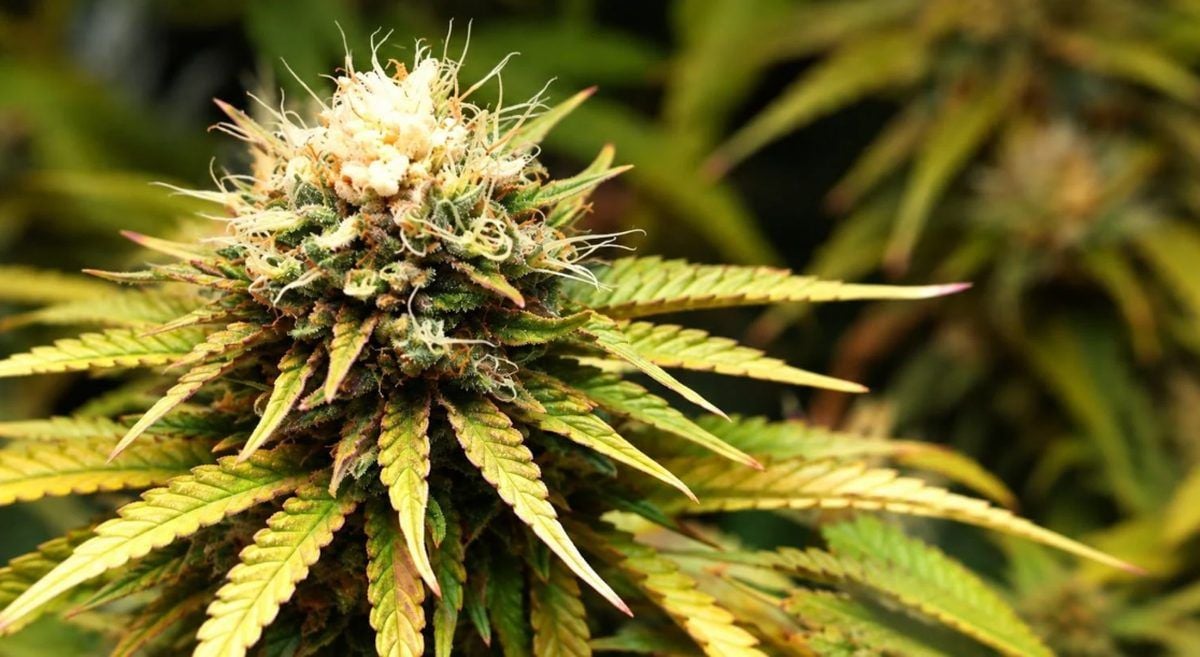
Keep in mind that LED fixtures can be a game-changer for tiny spaces, as they provide high-intensity, full-spectrum light while emitting minimal heat. This means that the lights can be closer to the plants without running the risk of damaging or burning the buds. Also, you can use a fan blowing between the canopy and LEDs or an AC unit to bring down the temperature and have the lights closer. Just keep in mind that LEDs can still burn your plants, but the risk is lower than with regular HPS or MH bulbs.
Maintain Healthy Roots
As you may know, the substrate is the home for the roots, and it’s where roots absorb water and nutrients. To get the most out of cannabis plants, especially smaller plants, the roots should be 100% healthy. So it’s highly recommended to use super soils or pre-fertilized substrates that contain everything, or at least the majority of the nutrients your plants need from seed to harvest, or as long as possible.
Remember to use a big enough pot to prevent plants from becoming root-bound. Make sure to check under the pots at least once every 2 weeks to see if the roots are exposed. If you see them coming from the drainage holes under the pots, it’s time to transplant them to a bigger pot to avoid major issues.
8. In Conclusion
Achieving big yields in small or even tiny spaces is definitely possible but it can be difficult if you don’t have much experience growing so it’s essential you know the basics about growing autos or photos, plant training, and everything you need for the specific grow setup you’ll be growing in. Once you know the basics, growing small plants is basically the same as growing big plants so don’t be afraid of trying, it’s definitely worth it.
If you've grown tiny plants before, feel free to help fellow growers by leaving your tips and tricks in the comment section below!
FAQ
There are several factors to consider when choosing between photoperiod and autoflowering strains. However, autoflowers are generally a great option for small grow spaces, especially if you're starting from seeds rather than clones.
Autoflowering strains tend to be more compact, require less training, and don't depend on changes in the light cycle to start flowering. This makes them particularly convenient for growers working with limited space. While both types of cannabis can thrive in micro grows, autoflowers can make the process simpler and more manageable, especially for beginners.
Yes, starting autoflowers in their final pots is generally recommended. Because autoflowering strains have a relatively short, genetically determined vegetative period, it's important to minimize unnecessary stress during their early growth stages.
Transplanting can temporarily slow growth if the roots are disturbed, potentially affecting the plant's overall development. Starting in the final container helps avoid this risk and allows the roots to develop without interruption. However, careful transplanting can still be successful when done correctly.
Technically, you can use HID lighting in a small growing space, but it's usually not the most practical option. Although HID lights can produce excellent results, they also generate considerable heat, which can be difficult to manage in a confined environment. Without adequate ventilation and temperature control, excess heat can stress your plants and negatively affect their growth. That's why modern LED grow lights are generally a better choice for micro grows. They're more energy-efficient, produce less heat for a comparable amount of usable light, and are available in compact designs that work well in limited spaces.
Heat management is one of the biggest challenges in small grow setups, so choosing an efficient LED panel can make things considerably easier. Fluorescent lights, such as CFLs and T5s, are another option for very small spaces, although they're generally less efficient than modern LEDs and may require more electricity to deliver comparable light levels.
Closets and cupboards are among the most common options for small indoor grows because they're compact, enclosed, and relatively easy to adapt. However, other spaces can also work, provided there's enough room for the necessary equipment and adequate ventilation. Compact grow tents are another popular option. They're available in various sizes and can be found online or at hydroponic supply stores. While some budget-friendly models may lack the durability or features of premium tents, they can still provide a practical starting point.
If discretion is a priority, odor control is another important factor to consider. Even a single cannabis plant can produce a strong smell during flowering, so a properly sized carbon filter and exhaust fan can help manage odors. Finally, make sure your chosen space has safe access to electricity and water. Avoid overcrowding electrical outlets, keep electrical equipment away from moisture, and ensure there's enough airflow to prevent heat and humidity from building up.
For most beginners, soil or coco coir are practical options for small-space cannabis cultivation. Both can be used in compact containers and generally require less equipment than a full hydroponic system. Soil is often the simplest choice, particularly when using a high-quality, pre-fertilized growing mix. It can provide nutrients during the early stages of growth, reducing the need for frequent feeding.
Coco coir is another excellent option, offering good aeration and drainage, although it typically requires more frequent watering and nutrient management. Hydroponics can also work well in small spaces, especially with compact systems, but it usually requires more equipment and closer monitoring. Ultimately, the best growing medium depends on your experience, available space, and how much maintenance you're comfortable with.
Comments