




How Many Autoflowers Can I Grow In A Square Meter?

- 1. What determines plant size in nature?
- 2. What determines plant size indoors?
- 2. a. Genetics
- 2. b. Pot size
- 2. c. Lights
- 2. d. Training
- 3. How to calculate the area of my growing space
- 4. Calculate number of plants based on pot size
- 5. Calculate light potency based on the number of plants
- 5. a. Leds
- 5. b. Light bulbs
- 6. How can plant training help me in these situations?
- 6. a. The tie-down method
- 6. b. Sea of green (sog)
- 7. In conclusion
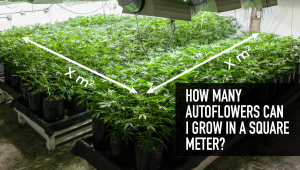
There are several things that help control the size of an autoflower. Things like genetics, lights, and pot size make it possible to grow up to 10 plants per 1 square meter. Almost all cannabis consumers who want to start cultivating their own cannabis want to fulfill their needs without having to spend too much. To do that, you have to make the most of your grow space.
In 2026, there are several things that can help you achieve that without having to spend more on another grow setup.
1. What Determines Plant Size In Nature?
When growing in nature, there’s nothing to limit a plant's size. As they’re not growing in closed space, cannabis grown outdoors can grow even more than 3 m tall. That, of course, doesn’t apply to indoor growers. Indoor growers have a limited amount of space, lights, nutrients, and medium. This can be seen as a bad thing, but it also gives us the ability to have complete control of our plant, being able to determine how tall, bushy, and even how many buds it will produce. To do that, we adjust the type of light and size of the pot. We can also apply plant training and pruning to adapt the cannabis to what we have available.
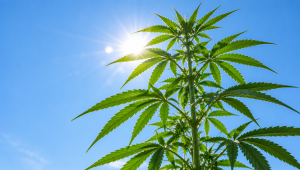
Sure, the environment plays a fundamental role when it comes to plant size. You can take two seeds of the same giant Sativa strain and experience two very different outcomes. If you were to place one seed directly in the ground outdoors in a sunny position, it would easily fulfill its genetic potential and become a towering and productive specimen. Place the other seed into a 10L pot, place it into a grow tent, and provide it with only 8 hours of light all day, and the same strain would grow to be much smaller and less productive.
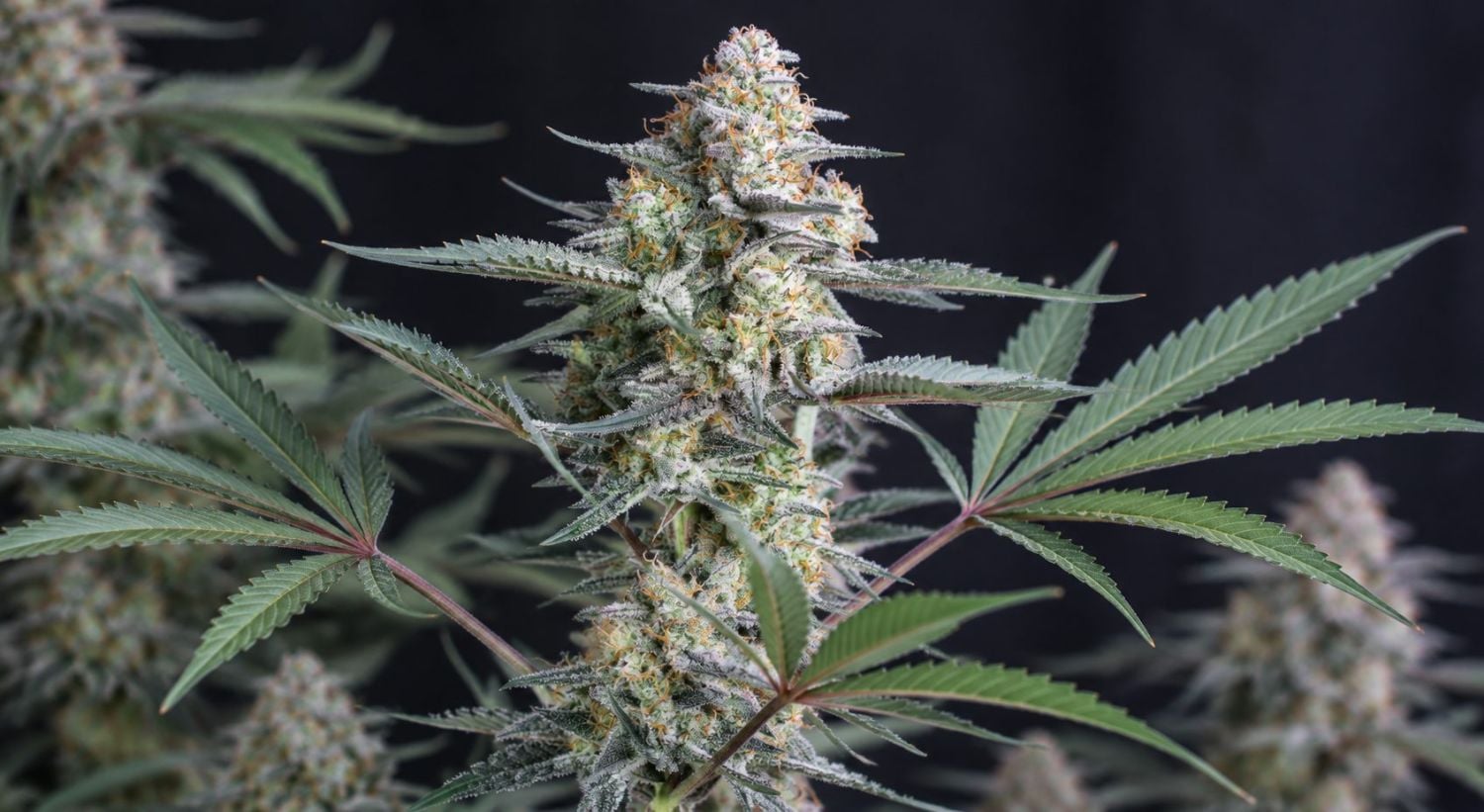
Environment aside, genetics also play a key role. This factor dictates how each subtype of cannabis will grow on the even playing field of nature. Large Sativa plants are almost tree-like in size and shape. In contrast, Indica-dominant specimens are naturally shorter and bushier. Then we have autoflowering plants. Because they contain Ruderalis genetics, they are the smallest strains available. They’ll only grow to a certain size, even when provided with unlimited space. This makes them ideal when growing in small spaces or looking to keep your growing operation as stealthy as possible.
2. What Determines Plant Size Indoors?
There are a couple of main factors that will determine the size your plant will grow. All of them can be adjusted to fit your preferences and can be adjusted according to your grow space and the genetics of the plant you’re growing, and can dictate how much cannabis can be yielded per square meter.
Genetics
As you may know, Sativas grow tall and thin, and Indicas grow short and bushy. This is one of the main factors that will affect how your plant grows. Even though nowadays it’s hard to find a pure Sativa or Indica, the hybrids most growers cultivate are a mix of pure Indica and Sativa genetics, and depending on the hybrid (it can be Sativa- or Indica-dominant), it will grow shorter or taller. A great example of a hybrid strain is our Z-Up Auto, which grows tall and bushy, showing characteristics of both Indica and Sativa lineage.
When calculating how many square meters per autoflower you need, this is the first thing we should have in mind. A Sativa-dominant hybrid can grow more than 2 m (6.5 ft) tall if no training is applied, while an Indica hybrid can reach up to 1.4 m (4.5 ft) tall. So, if you’re looking to grow Sativa-dominant strains, you won’t be able to fit as much in your grow tent as if you were growing Indica-dominant cannabis. You also need to take into account whether you will be growing autos or photoperiod cannabis plants. But what exactly is the difference?
Normal photoperiod plants can be forced to stay in the vegetative growth stage through the control of the light cycle. As long as you keep the lights on for 18+ hours per day, a photoperiod plant will never go into flower. But with Autoflowers, there is an inbuilt timer that will automatically switch the plant into the flowering growth stage no matter what the light schedule.
But why would someone choose to grow autos over regular plants? Well, that’s pretty simple:
- They take much less time and have a much faster lifecycle, with the entire grow taking the same or sometimes less time than just the flowering stage for photoperiod plants.
- They make discreet cannabis cultivation easy since they usually stay under about 1.2 meters in height.
- Since they flower under any lighting conditions (even 24 hours), it makes setting up a perpetual harvest routine much simpler. You can have plants at any stage of their lifecycle in the same grow area without having to worry about how they will be affected.
- Ruderalis genes are extremely resilient. They usually offer better natural protection from pest, bacterial, and mold infestations than photoperiods.
- They deal with light pollution issues much better than photoperiod plants. Have you ever tried to grow a photoperiod plant outdoors only to realize that the streetlights are causing flowering issues, or maybe you have had some indoor plants turn hermie thanks to light leaks? Not an issue with autos whatsoever.
They do come with a few small downsides, though, depending on how you like to grow:
- Cannot be kept in veg indefinitely. This can be easily offset by planting a couple more plants, but it is something to keep in mind.
- No way to grow from clones. Autos must be cultivated from seed, as any clones will stick to the flowering timing of the mother plant, meaning there is simply not enough time for the plant to develop before flowering begins.
Pot Size
Pot size is another very important factor. The amount the roots grow underneath will reflect directly in the size of your plant, so if you grow in a 5 L pot, your plant will be smaller than if you grow in a 10 L pot. Even if there’s a difference in the size of Sativa- and Indica-dominant strains, pot size will decrease their overall size, as they won’t have space for the roots to grow. The size of the above-ground aerial part of a cannabis plant is a reflection of what’s going on beneath the soil. Outdoors, plants have plenty of space to spread out their roots, which results in bigger plants. Indoors and in small pots, plants are much more limited. The roots grow outwards and downwards until they make contact with the side of the container. From here, they begin to spiral and grow more chaotically, continually looking for any spare space to grow into. Eventually, they develop a ball-like structure and become rootbound.
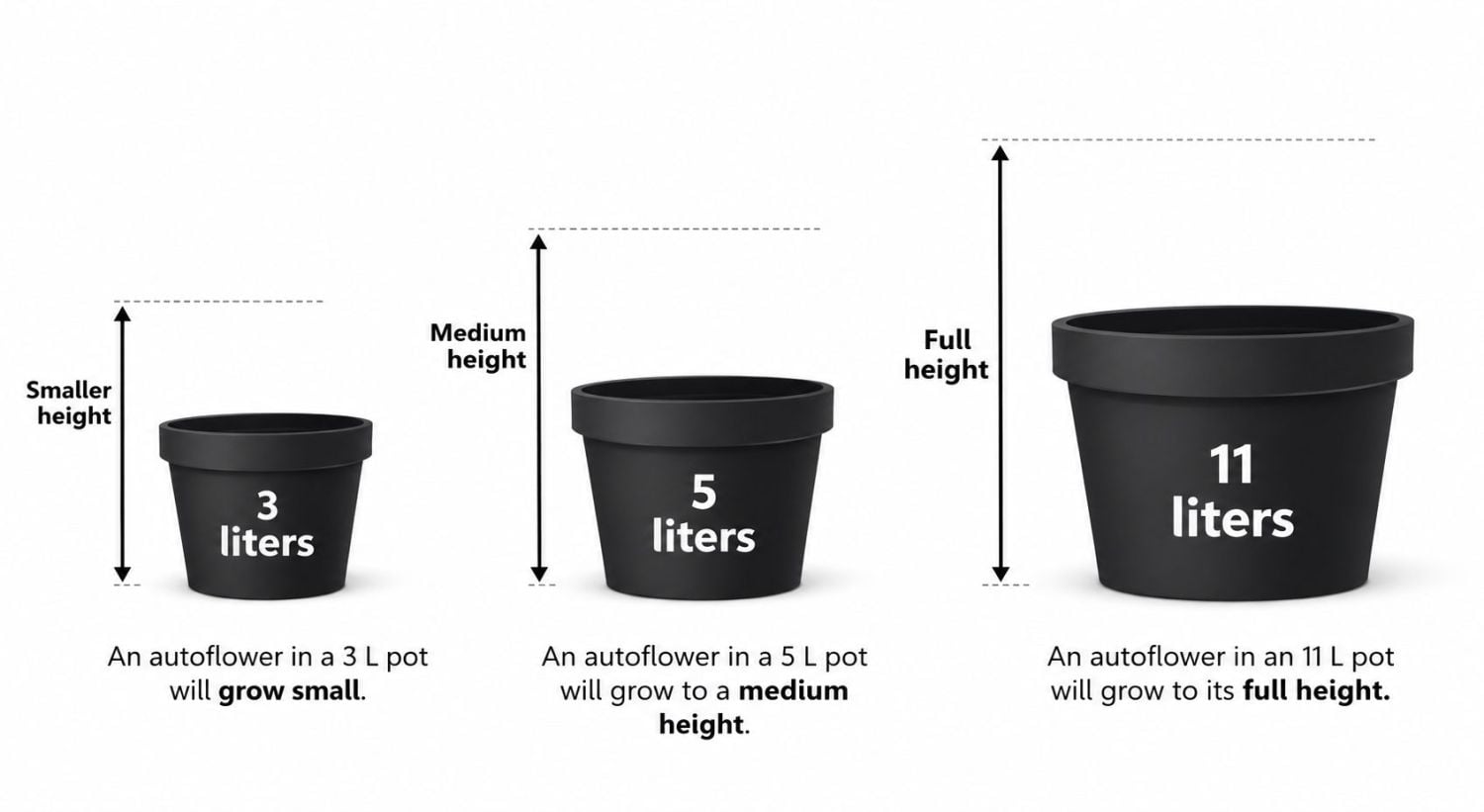
For autoflowers, we recommend not going too big when choosing the pot size. Usually, an autoflower in an 11 L pot will grow to its full height, whereas an autoflower in a 5 L pot will grow to a medium height, and in a 3 L pot will grow small. If you don’t have space issues, we recommend going with 11-12 L pots so your plants can develop to their fullest. You might be tempted to select a much bigger pot size. That will result in a large and more productive plant, right? Not quite. Sure, your plant will grow slightly larger, but small autos quickly hit their limit. An overly sized pot can cause water to pool at the bottom of the container, resulting in anaerobic conditions that breed pathogenic anaerobic bacteria that can cause root rot.
Lights
Light coverage and intensity will also influence not only the size but also the amount of resin and density of buds. When you grow too many plants in a small space, some will throw shade over others, and the ones left underneath will not be able to develop properly. That’s why you need to know the size of your grow space before buying the grow lights. This will ensure you get good coverage that can satisfy all your cannabis plants.
Training
There are numerous plant training techniques. Even though the methods vary, all of them have the same goal: adjust and shape your plant to optimize the growing space. For autoflowers, we recommend using low stress training (LST) techniques or using the Sea of Green (SOG) method to make the most out of your grow room.
3. How To Calculate The Area Of My Growing Space
Calculating the area of your space is fairly simple. To do this, we need a measuring tape to measure the length and width of our growing space. If we are planning to grow in a grow tent, we can find this information in the manual, but if it isn’t available, it is fairly simple to measure it. So, for example, if, after measuring, the length of our growing space is 1 m (3.2 ft) and the width is 1 m, we multiply both to get the total area, so: 1x1 = 1 square meter(10.2 ft). This applies to any size, even if our growing space is not a perfect square. Another example is: length = 2 (6.5 ft) and width = 3 (9.8 ft), we would have an area of 2 x 3 = 6 square meters (64.5 ft2).
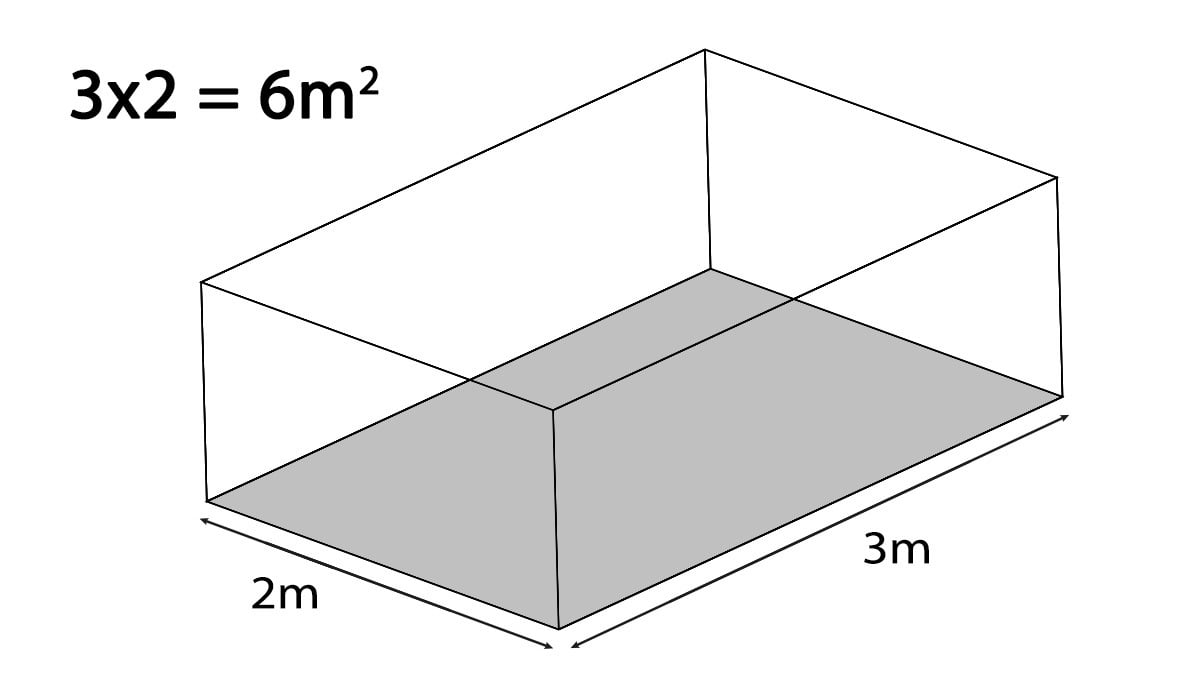
This is extremely helpful because, based on the area of our growing space, we can calculate the potency of the light we will need and the plants we can fit in it. If you’re measuring in cm, divide the result by 100 to have the area size in m2. For example: 200 x 400 = 800 cm2, 800 cm2 ÷ 100 = 8 square meter.
Follow the same logic to obtain the area in square feet.
4. Calculate Number Of Plants Based On Pot Size
For these examples, we will use a space of 1 square meter, but you can do the math with your space’s measurements, and you will have the same result. Calculating exactly how many plants we can fit in our space or how many square meters per autoflower you need can be difficult. This is a general guide and may vary depending on your growing environment. Pots come in different shapes and sizes, and depending on the size, you will be able to fit several in your grow space. There’s no general rule, but depending on the size of the pot you choose, you will limit the size of your roots, which will have a direct impact on the plant’s size.
Usually, we use the following table as a guide:
| Pot Size | Number Of Plants Per m2 | Plant Size |
|---|---|---|
| 3 L (0.6 gal) | 25 | Small/medium plant height |
| 5 L (1.3 gal) | 18 | Medium plant height |
| 11 L (2.9 gal) | 9 | Full plant height |
| 15 L (3.9 gal) | 5 | Full plant height |
| 18 L (4.7 gal) | 2 | Full plant height |
| 21 L (5.5 gal) | 1 | Full plant height |
Keep in mind that the last thing that cannabis plants like is to be cramped. There is a tendency for new growers to want to fit as many plants as possible into their grow area, and this makes perfect sense to the uninitiated. Why go to all the effort and cost that is involved in setting up a grow room and then not capitalize on every last square inch? This is actually the wrong way to think about it. In general, cannabis plants will thrive when they have just that little extra bit of space. Cramped grow tents and rooms are breeding grounds for fungal, bacterial, and pest issues. Air movement in the canopy is key in combating these issues, so keep that in mind when choosing how many plants to have in the grow space.
5. Calculate Light Potency Based On The Number Of Plants
There are two types of light fixtures: Light bulbs and LEDs.
LEDs
With LEDs, it’s impossible to calculate because the quality of the individual LEDs changes from one manufacturer to another. The best thing is to follow the recommendations of the manufacturer that should be in the manual of the light fixture. If not, we recommend sending them an email asking for the information. If you tried everything and cannot find the information you need, you can follow the general rule: a 250 W LED is equal to a 400 W light bulb. As said before, this is not always true and is only to be followed if you can’t find any other information about the LEDs you’re buying (almost all decent LEDs provide the area coverage, and you shouldn’t worry too much about this).

Even though it’s not recommended because every LED is different, if you still want to use this guide for LEDs, you will have to divide the number of watts by 1.6. So if you were to need 2500 W of light bulbs, in LED it would be 2500 W ÷ 1.6 = 1562 W of LED
Light Bulbs
Now, with light bulbs, this is different, and there indeed is a way to calculate the wattage you will need for your plants. This way, you are not calculating how many square meters per autoflower you need but how much light you need. Let’s continue with the example we were following before. We have a space area of 6 square meters (64.5 ft2), and we already know we can fit 30 plants in it. What’s the wattage we will need? So, as an example, let’s assume we can fit 30 plants in that area. What’s the wattage we will need?
Usually, you would need around 75 W per plant, so by following the table, we can calculate how many watts we would need for 30 plants in a 6-square-meter (64.5 ft2) space.
| Wattage | Number Of Plants |
|---|---|
| 150 W | 2 |
| 250 W | 4 |
| 400 W | 6 |
| 600 W | 8 |
| 1000 W | 14 |
If you’re growing fewer than 14 plants, you can just look it up on the table. If you’re growing more, like in the previous example, you need to multiply the number of plants by 75 W. So in our example, it would be 30 x 75 W = 2250 W. This means we would need 2250 W to grow 30 plants in 15 L pots in a 6 square meter (64.5 ft2) growing space.
6. How Can Plant Training Help Me In These Situations?
Even though there are a lot of plant training techniques, there are only a few that can be done on autoflowers without any problems. They are the Tie-Down method and the Sea of Green.
The Tie-Down Method
With this technique, you will help the branches open up, allowing light to reach deeper, resulting in multiple bud sites and denser buds. By doing this, you will be able to fit fewer plants in your grow space, but you will get a bigger yield. Continuing our example, if we had 6 square meters (64.5 ft2) of growing space, we would be able to fit 30 plants. If you applied this method, that would be lowered to around 15 plants, depending on the pot size.
Sea Of Green (SOG)
When growing in a Sea of Green, the number is higher than in the Tie-Down method and also higher than growing the plant without any kind of training. This is because plant training methods aim to control a plant's size while also yielding as much as possible. This method consists of slowly training your cannabis into an even canopy, allowing light to reach all bud sites equally. The following is a general guide, and as said before, you can have more or fewer plants depending on your skills and needs.
For both plant training methods, you can follow the chart below as a guideline:
| Pot Size | Plant Number Per m2 |
|---|---|
| 3 L (0.6 gal) | 16 |
| 5 L (1.3 gal) | 12 |
| 11 L (2.9 gal) | 6-8 |
| 15 L (3.9 gal) | 4 |
7. In Conclusion
The square meter per autoflower will depend on several things. There’s no exact number of plants you can fit in your grow tent, independent of the size. What will truly define that is a combination of your budget, genetics, equipment, and environment. So if you were wondering how many autoflowers per square meter to grow or how much an autoflower can yield per square meter, it can be quite complicated, but doing the math will give you an idea.
Remember that everything explained in this article will depend on growing conditions, genetics, and how well you take care of your plants. As mentioned, you may be able to fit more (or less) autos per square meter depending on the plant training techniques you perform. Also, it's very important to have in mind that some cannabis may grow tall despite being in smaller pots, and others will not grow much even if they're growing in bigger pots, so as you finish each grow cycle, you will have a better idea of not only how that specific strain grows but also what it needs and what you have to provide for it to thrive.
Have in mind that all cannabis plants are different and they will grow according to the environment they're in, so even if it's the same strain, growing it outdoors and indoors will result in slightly different (or completely different) growth, which can be seen in how much your plants stretch, yields, aromas, and effects, so if you are planning on cloning a certain plant, make sure you grow it in similar conditions, either outdoors or indoors.
If you are looking for plants to grow in smaller pots and haven’t decided what to grow in your next cycle yet, we recommend our Purple Haze Auto. On the other hand, if you are looking to grow fewer plants but bigger, we recommend our Lemon Cherry Sundae Auto.
And remember that this is just a guide, so there can be tiny differences in the plants you can fit and light your cannabis needs according to the elements mentioned throughout the article. This guide will help novice growers figure it out, but it’s all a matter of preference.
FAQ
4 to 6 autoflowers in bigger pots per square meter provides a practical balance between plant size, airflow, and available growing space. The ideal number depends on the genetics and expected mature size of each plant.
Yes, you can fit 10 compact autoflowers in a square meter, especially with smaller containers. However, overcrowding can restrict airflow, reduce light penetration, and create competition for space.
Yes, pot size plays an important role in plant spacing. Larger containers take up more floor space and generally support larger root systems, while smaller containers let you fit more plants in the same area.
A 60 × 60 cm grow tent provides 0.36 square meters of growing space. Depending on the expected plant size, this area may accommodate approximately 1 to 4 compact autoflowers, although larger varieties may require the entire space.
An 80 × 80 cm tent provides 0.64 square meters of floor space. Around 2 to 5 autoflowers may fit, depending on their mature size, container dimensions, and canopy spread.
Neither approach is automatically better. Fewer large plants offer more individual growing space and easier access, while more compact plants can create a fuller canopy. The best arrangement depends on plant genetics, available equipment, and growing conditions.
The space required by an autoflower varies with its genetics and mature size. A compact plant might occupy approximately 30 × 30 cm, while a larger autoflower could require 50 × 50 cm or more of canopy space.
Yes, lighting coverage influences how evenly plants receive illumination. A crowded canopy may prevent sufficient light from reaching lower leaves and branches, even when the total growing area appears fully utilized.
Yes, overcrowding can negatively affect plant health. Dense foliage may restrict airflow, increase humidity around leaves, and encourage fungal problems. Plants can also compete for light and physical space.
Autoflowers can increase significantly in size during the transition into flowering. Their branches and foliage may spread beyond their initial footprint, making it important to consider mature plant dimensions rather than seedling size.

Comments